
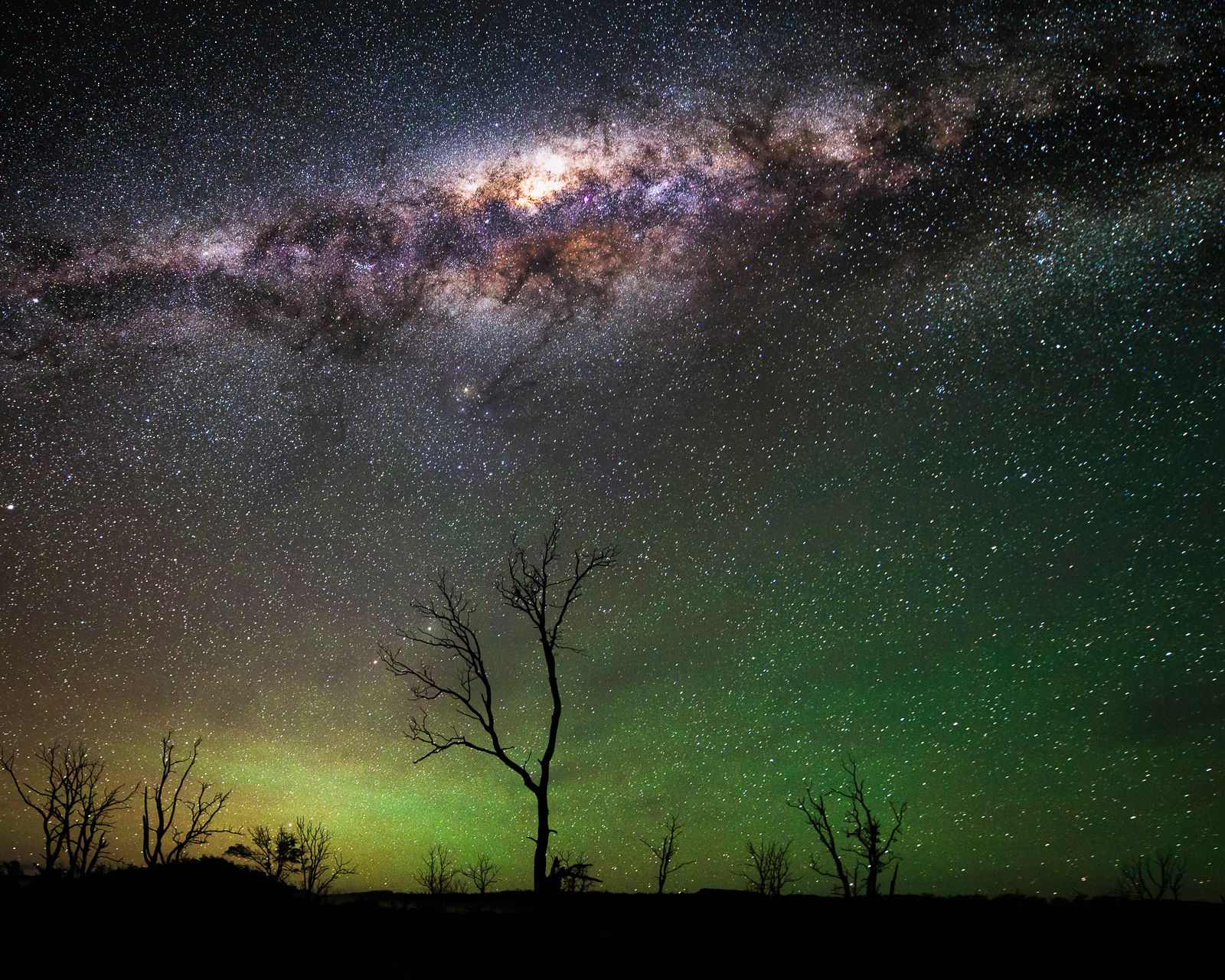
There are places in the world where the Milky Way is so bright it casts shadows. Tasmania is one of them.
I’ve photographed the night sky from a lot of locations over the years, and Tasmania consistently ranks among the best. The combination of dark skies, dramatic landscapes, clear southern hemisphere views of the galactic core, and relative accessibility makes it exceptional. On a good night from the right location, the Milky Way arch is bright enough to navigate by.
Why Tasmania?
Dark skies. Most of Tasmania’s interior and west coast registers as Bortle Class 1-2 – the darkest classification on the scale used by astronomers. There are virtually no cities west of Hobart and the Southern Ocean stretches to Antarctica. Light pollution is minimal by any global standard.
Southern hemisphere advantage. The galactic core – the brightest, most dramatic part of the Milky Way – is best viewed from the southern hemisphere. In Tasmania you’re looking directly toward the centre of the galaxy in a way that northern hemisphere photographers can only dream about. It’s higher in the sky, brighter, and more detailed than anything visible from Europe or North America.
Extraordinary foregrounds. Dolerite peaks, alpine tarns, ancient rainforests, dramatic coastlines. Tasmania’s landscapes are as good as the sky above them. The best Milky Way images combine a compelling foreground with a spectacular sky – Tasmania delivers both.
When to shoot
The galactic core is visible from roughly March through October, with peak season being April through August. This coincides with longer nights and gives you more dark sky time to work with.
Moon phase matters more than anything else. A full moon washes out the Milky Way completely. Shoot during the new moon window – the few days either side when the moon is below the horizon or too thin to matter. Plan around the lunar calendar and you’ll never waste a trip.
Where to go
Lake Pedder and the Southwest – Bortle Class 1 darkness, extraordinary mountain and water reflections. Two hours from Hobart on sealed road. The lake surface on a still night produces reflections of the galactic core that are almost surreal.
Freycinet Peninsula – Pink granite foregrounds, reliable clear nights, ocean horizons. The east coast gets less rain than the west, making clear nights more predictable.
Cradle Mountain – Dove Lake with the mountain reflected under the Milky Way is one of the iconic images of Australian astrophotography. Stay overnight to be at the lake before the tourist shuttle buses arrive at dawn.
The alpine zone – The tarns and dolerite peaks of Tasmania’s alpine zone make for the most dramatic foregrounds. Kitchen Hut on the Overland Track, the tarns above Lake Dobson at Mount Field, and the remote Southwest wilderness produce images that are genuinely difficult to shoot anywhere else on Earth.
Camera settings
ISO: 3200-6400 on a modern full-frame sensor. Don’t be afraid of noise – modern noise reduction handles high ISO well, and a noisy image of the Milky Way beats a clean black frame.
Aperture: As wide as your lens will go. f/2.8 is ideal, f/4 is workable.
Shutter speed: Use the 500 rule – divide 500 by your focal length to get the maximum shutter speed before stars trail. On a 24mm lens that’s about 20 seconds. On a 14mm lens you can push to 35 seconds.
Focus: Manual, to infinity. Use live view zoomed in to 10x on a bright star. Check it after every lens change and every time you move location.
White balance: Shoot RAW, set around 3800-4200K.
Composition
The biggest mistake in Milky Way photography is treating the sky as the only subject. The images that stop people are the ones where the foreground is as compelling as the sky above it. A still tarn reflecting the galactic core. A lone tree silhouetted against the arch. A mountain peak framing the core.
Spend time at your location during daylight before shooting at night. Find the compositions that work, note the interesting foreground elements, and plan where the core will be relative to them. Use PhotoPills or The Photographer’s Ephemeris to plan exactly where the galactic core will be at a given time and location.
Practical notes
Tasmania’s nights get cold fast, especially in the alpine zone. In winter, temperatures above 1000 metres regularly drop below zero. Dress in layers, bring more warm clothing than you think you need, and keep spare batteries in an inner pocket – cold kills battery life fast.
A red headtorch preserves your night vision. White light destroys dark adaptation and you’ll need 20-30 minutes to recover it.
Tell someone where you’re going, especially for remote locations. Tasmania’s wilderness is serious country and the weather changes fast.
Join a Milky Way workshop
I run astrophotography workshops through Tasmanian Photography Tours, covering Milky Way and aurora photography at Tasmania’s best dark sky locations. Small groups, real locations, genuine field time. Check availability at Tasmanian Photography Tours.
Milky Way and night sky prints are available in the Astro gallery. Fine art paper prints, canvas, and metal prints through the store.