
I’ve been photographing Tasmania for over twenty years. In that time I’ve covered most of the island – from the remote southwest to the east coast bays, from the alpine zone to the rainforest floor. These are the locations I keep coming back to. Not because they’re the most Instagram-famous, but because they consistently deliver the kind of light and landscape that makes the early start worth it.
1. Mount Anne and the Southwest National Park
The most demanding location on this list and the most rewarding. Mount Anne requires an overnight trip minimum – the trailhead is a three-hour drive from Hobart and the approach hike takes several hours. But the alpine tarns, dolerite peaks, and almost total absence of other people make it one of the most extraordinary landscape photography destinations in Australia.
The light at dusk and dawn here is something else entirely. The pink and purple tones that hit the quartzite and dolerite in the last hour of light are unlike anything I’ve seen anywhere else. Come prepared for all weather – it changes fast and it changes hard.
Best for: Alpine landscapes, tarns, sunset/sunrise, solitude
Difficulty: High – requires multi-day hiking and navigation skills
Season: November to April (alpine tracks can be dangerous in winter)
2. Mount Field National Park
The most accessible location for serious landscape photography within an hour of Hobart. Mount Field has everything – Russell Falls and the rainforest below, the Tarn Shelf and alpine vegetation above, and in autumn the fagus and fungi season that makes it one of the most photographed places in Tasmania.
The Lake Dobson road takes you from tall eucalypt forest through subalpine zone to the alpine tarn country in about 20 minutes of driving. Sunrise from the tarn area is spectacular. The rainforest around the falls is best on overcast days when the light is soft and even.
Best for: Waterfalls, rainforest, fagus (autumn), fungi (autumn), alpine tarns
Difficulty: Low to moderate – well-maintained tracks, day walk options
Season: Year-round, exceptional in April-May
3. Freycinet Peninsula and Wineglass Bay
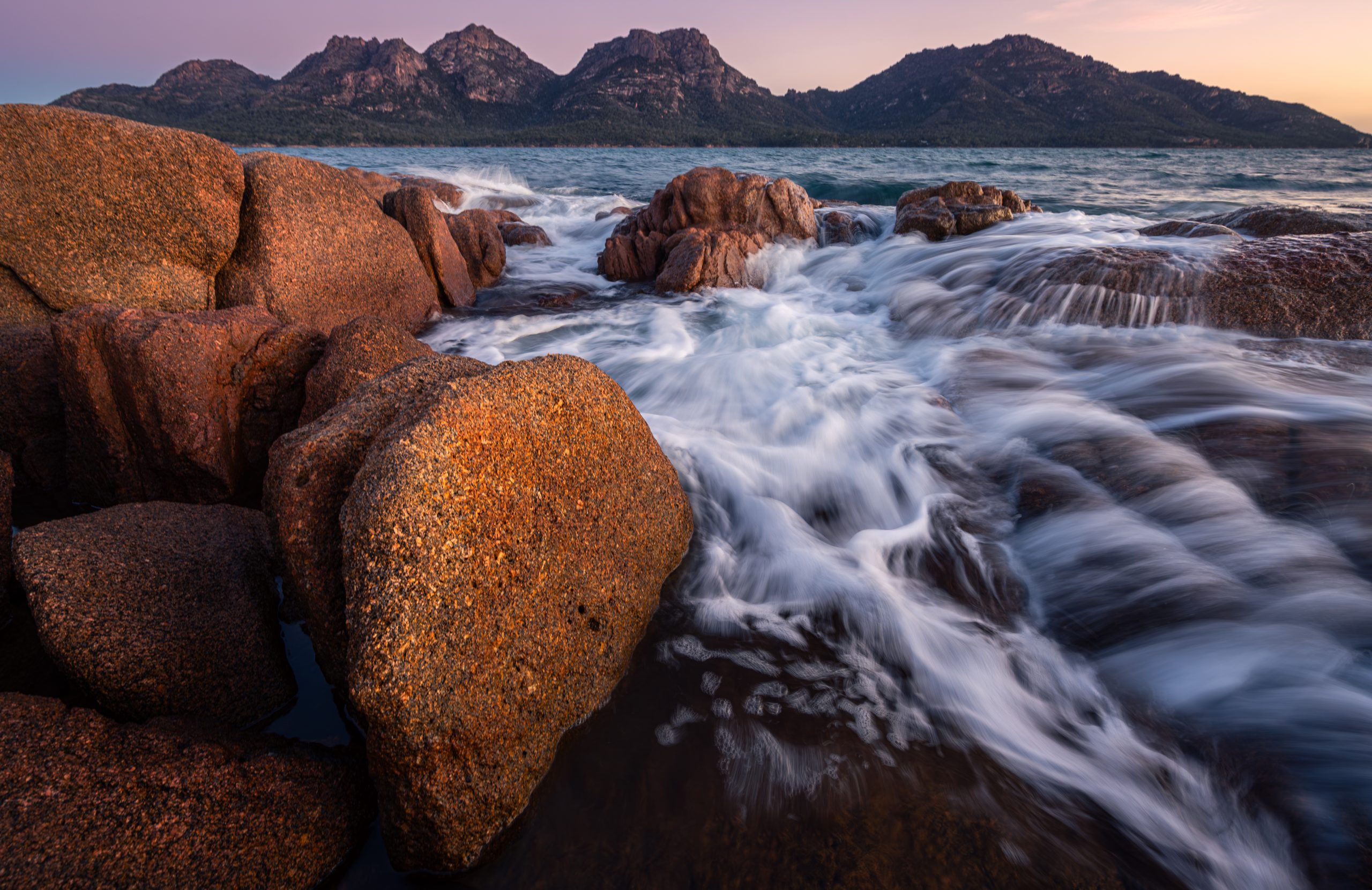
Tasmania’s most famous view is famous for a reason. The pink granite of the Hazards, the arc of white sand, the deep blue of the bay – it’s genuinely extraordinary and it photographs well in almost any light. The challenge is that everyone knows about it, so the lookout can be crowded at peak times.
The less-photographed side of Freycinet is equally compelling. The east-facing beaches catch the first light of the morning in a way that’s hard to find elsewhere in Tasmania – the combination of pink granite, clear water, and early light is exceptional. I’ve also had some of my best Milky Way shots from this peninsula, with the rock formations and ocean as foreground.
Best for: Coastal landscapes, sunrise, astrophotography
Difficulty: Low – well-maintained national park tracks
Season: Year-round, best light in summer mornings
4. The Tarkine / Takayna
The largest temperate rainforest in Australia and one of the least-visited wilderness areas in the country. The Tarkine is for photographers willing to get off the main roads and spend time in places most people never reach. The forest is extraordinary – ancient myrtles, tree ferns, mossy logs, and the kind of quiet that you don’t find anywhere near a road.
The west coast beaches here are also among the most dramatic in Tasmania – black sand from the Southern Ocean, driftwood and kelp, and light that can be extraordinary when a break comes in the cloud.
Best for: Rainforest, west coast beaches, solitude
Difficulty: Moderate to high – some areas require 4WD or significant walking
Season: Autumn and spring for best forest conditions
5. Cradle Mountain
The most iconic view in Tasmania and deservedly so. Dove Lake with the mountain reflected in it at dawn is one of those images that earns its reputation – when the conditions are right, it really is that good. The challenge is the crowds and the unpredictable weather.
My advice: stay overnight in the area and walk to Dove Lake before the shuttle buses start running. The light in the first hour after dawn, with the mountain to yourself, is worth the early start. The Enchanted Walk through the pencil pine forest is also exceptional for intimate forest photography.
Best for: Iconic mountain views, pencil pines, reflections, fagus (autumn)
Difficulty: Low to moderate
Season: Year-round, exceptional with snow in winter and fagus in autumn
6. The Tasman Peninsula
The dolerite sea cliffs of the Tasman Peninsula are some of the tallest in the southern hemisphere and they make for dramatic coastal photography. The Tessellated Pavement at Eaglehawk Neck is extraordinary in the right light – a geometric rock formation that looks designed rather than natural. Tasman Island and Cape Pillar are accessible by sea kayak or boat tour and the photography from the water looking up at the cliffs is extraordinary.
Best for: Sea cliffs, coastal geology, seascapes
Difficulty: Low to moderate (coast tracks), high (sea kayak)
Season: Year-round
Practical notes
Tasmania’s weather is famously changeable. What looks like a clear forecast can become rain, wind, and fog within hours, especially in the west and southwest. This isn’t a reason to stay home – dramatic weather makes dramatic photographs. But it is a reason to have wet weather gear, to tell someone where you’re going, and to have a backup plan.
The light here in the golden hours is exceptional – further south means longer golden hours in summer and shorter ones in winter, but the quality of the light when it appears is something photographers travel from around the world to find.
Images from many of these locations are available in the Galleries. Fine art prints available through the store. To visit these locations with a guide, see photography workshops.