
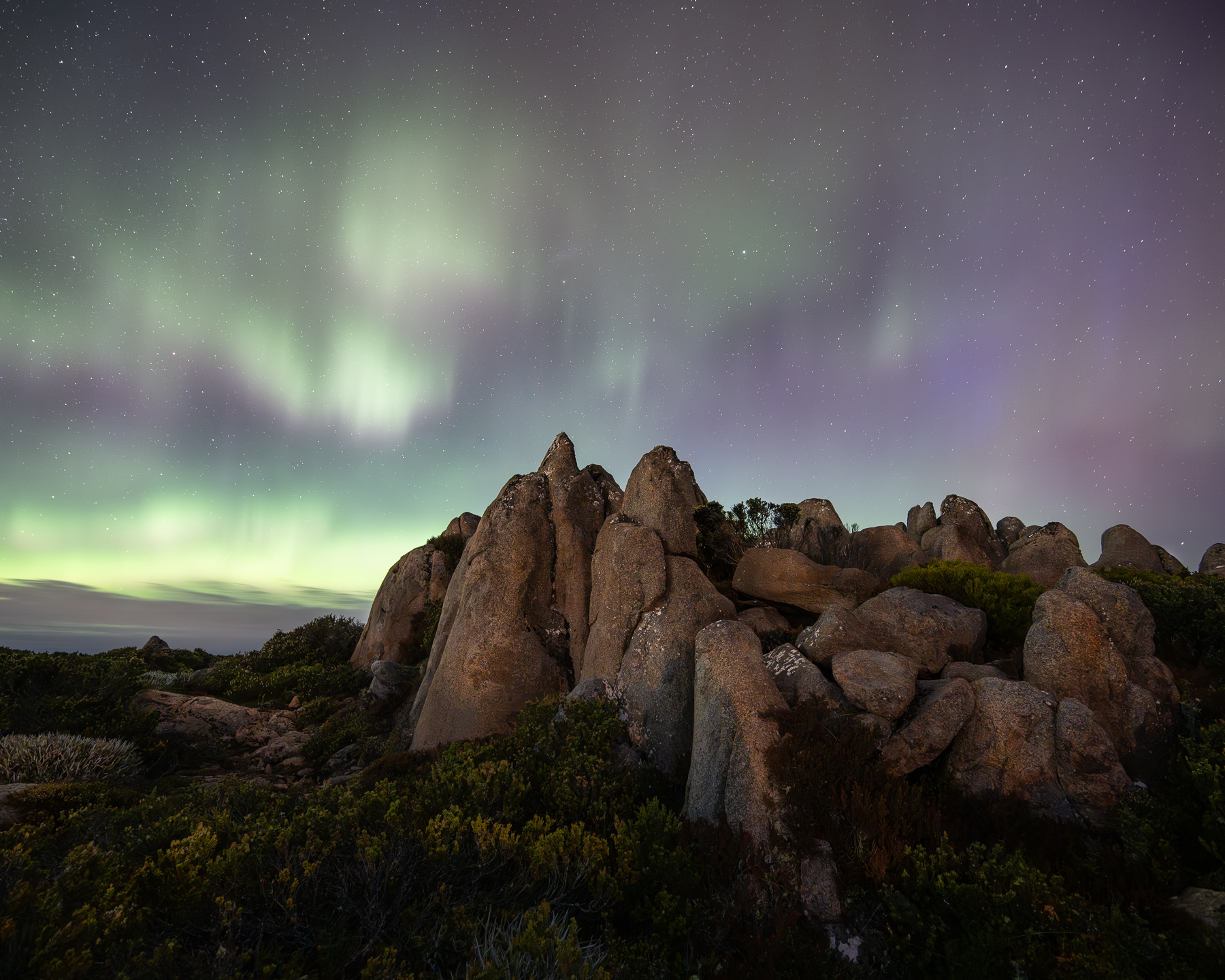
The forecast said Kp4. Possible aurora activity for southern Tasmania. I’d seen that forecast a hundred times and driven out anyway, usually to stand in a paddock for two hours watching nothing happen. But you go. You always go. Because the one time you don’t is the time it happens.
This particular night it happened. Within twenty minutes of arriving at my location south of Hobart, the southern horizon started to glow. Not the faint greenish smear you sometimes see that might be aurora or might be light pollution. This was colour – deep purple at the base, green curtains rising, pink at the top. Moving. The whole sky was alive.
Why Tasmania is one of the best places on Earth for aurora
Tasmania sits at roughly 42-43 degrees south – far enough to regularly see Aurora Australis, but accessible enough that you don’t need an expedition. The island has minimal light pollution, a clear southern horizon over open ocean, and some of the most dramatic landscapes in the country to use as foreground. During solar maximum – which we’re currently in – the frequency and intensity of events has been extraordinary.
How to know when aurora is coming
The Kp index is the main number to watch. It runs from 0 to 9. For Tasmania, Kp3 or above can produce visible aurora. Kp5+ usually means a significant display. Kp7+ is a major storm – full-sky colour visible from the city.
Space Weather Live (spaceweatherlive.com) shows real-time Kp readings and forecasts. Set up a Kp4 alert and you’ll never miss a significant event.
The Aurora Australis Tasmania Facebook group has thousands of members posting real-time sightings. When something significant starts, you’ll know within minutes.
Cloud cover matters more than Kp. A Kp7 event behind cloud is invisible. Check BOM’s cloud forecast for southern Tasmania before you drive anywhere.
Where to go
South of Hobart – anywhere along the Channel or Huon Highway with a clear southern view. Kingston Beach, Coningham, Verona Sands, and the Huon Valley are all within 30-45 minutes of the city. Drive until the city lights are behind you.
Cockle Creek – the southernmost point accessible by car in Australia, two hours from Hobart. One of the best aurora locations in the country. Worth every minute for a significant event.
The east coast – Marion Bay, Bicheno, and Freycinet all offer excellent southern horizons over open ocean. The reflection on the water on a strong night is extraordinary.
The alpine zone – catching aurora from a mountain location with snow or tarns in the foreground is the holy grail. The logistics are harder but when it comes together the results are unlike anything else.
Camera settings
ISO: Start at 1600-3200. Push to 6400 if the display is faint.
Aperture: As wide as possible – f/2.8 or wider.
Shutter speed: 10-20 seconds for slow aurora, 2-5 seconds for fast-moving curtains. Long exposures blur active displays into a smear.
Focus: Manual, to infinity. Use live view zoomed in on a bright star.
White balance: Shoot RAW, set around 3500-4000K.
What aurora actually looks like
Aurora looks different to the naked eye than in photographs. On a moderate night, what you see might be a pale greenish glow – what the camera records is vivid curtains. The colour is really there, your eyes just aren’t as sensitive as the sensor. On a strong display, Kp6 or above, the difference narrows significantly. Those nights the curtains move in real time and the experience is genuinely overwhelming.
Join an aurora photography workshop
I run astrophotography workshops through Tasmanian Photography Tours covering night sky photography including aurora technique – location scouting, camera settings, composition, and the forecasting tools that give you the best chance of being in the right place at the right time. Check availability at Tasmanian Photography Tours.
Aurora Australis prints are available in the Astro gallery. Fine art paper prints, canvas, and metal prints through the store.