
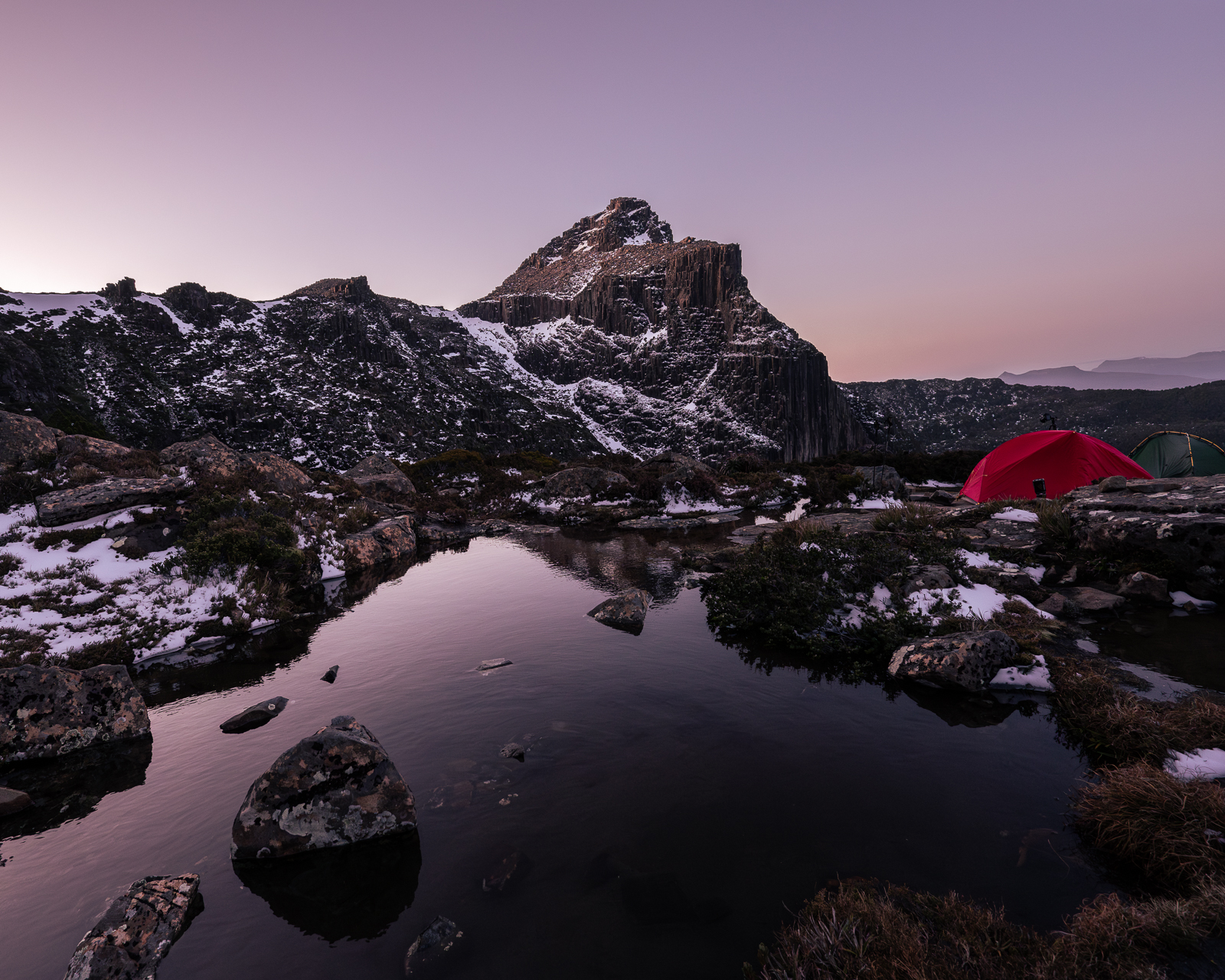
The plan was simple. Two days, one night, summit of Mount Anne, get the shot I’d been thinking about for years. The reality, as it usually is in Tasmania’s southwest, was more complicated.
I’d been watching the forecasts for weeks. The southwest is notoriously difficult – systems roll in from the Southern Ocean with almost no warning, and the terrain is serious enough that getting caught out isn’t just uncomfortable, it’s dangerous. The window I was waiting for was a clear evening, calm overnight, cloud moving in before dawn. The kind of conditions that produce something extraordinary at first light.
It came in late autumn. I drove to the Condominium Creek trailhead in the dark, shouldered a pack that was heavier than I’d have liked, and started walking.
The approach
The Mount Anne Circuit is one of Tasmania’s most demanding day walks – or in this case, an overnight trip that requires you to carry everything you need including enough water, since sources above the plateau can be unreliable depending on conditions. The track climbs steeply from the car park through tall eucalypt forest, transitions to subalpine scrub, and then breaks out onto open quartzite ridge that feels like the edge of the world.
I reached the high camp site – a relatively sheltered spot below the final summit push – in the early afternoon. Made camp, ate something, checked the forecast again. Still clear. Still calm. The evening light on the dolerite was turning golden by the time I had everything sorted.
Then I walked to the edge of the plateau and saw what I’d come for.
The view
The southwest of Tasmania from above is one of the most extraordinary landscapes I’ve seen anywhere in the world. Layers of quartzite ridges, button grass plains, the dark lines of rivers, tarns everywhere catching the sky. No roads. No buildings. Nothing made by humans as far as you can see in any direction.
The light that evening was warm and clear, turning the quartzite a deep orange-gold. I shot for two hours, working different compositions as the sun dropped. Below me, my tent was a small red dot beside one of the tarns. I came back to that composition again and again – the tent anchoring the foreground, the mountains behind, the sky above. There’s something about a tent in wilderness photography that tells the whole story in one frame. Someone is here. Someone chose to be in this place, at this moment.
The best image from that evening is now the first thing people see when they visit this site.
The night
The forecast held. The night was clear and cold and absolutely still. I shot the Milky Way from the tarn edge for two hours, then crawled into the sleeping bag and slept better than I had in weeks. There’s something about physical exhaustion at altitude in clean air that produces a quality of sleep you simply can’t replicate anywhere else.
I was back outside at 4am, before the cloud I’d hoped for had arrived. The stars were still sharp and the horizon to the west was showing the first faint lightening. I set up in the same spot I’d been shooting from the evening before and waited.
The light
The cloud arrived just before dawn, exactly as forecast. A thin layer that diffused the first light without blocking it entirely. The effect was extraordinary – soft, directional light coming over the eastern ridgeline and hitting the quartzite and dolerite at a low angle, with the cloud layer above turning pink and then gold.
I shot almost continuously for forty minutes. The light changed every few minutes as the sun climbed and the cloud shifted. Some frames were too soft. Some were too dramatic. There was a window of about eight minutes where everything was exactly right – the light, the cloud, the colour on the peaks, the reflection in the tarn.
The images from those eight minutes are the best I’ve ever made in Tasmania.
Getting there
Mount Anne is not a walk to take lightly. Some practical notes if you’re planning it:
Access: The Condominium Creek trailhead is about 115km from Hobart via the Westerway and Strathgordon roads. The road is sealed all the way and the drive takes around two hours. There’s a basic toilet at the car park but no other facilities.
Track difficulty: The track to High Camp is steep and requires some scrambling on the upper section. The summit ridge involves exposed scrambling on loose quartzite. This is not a casual walk – it requires experience in alpine terrain, good navigation skills, and appropriate gear.
Water: Carry more than you think you need. There are usually tarns near the high camp area but they can be frozen or contaminated depending on conditions. Treat all water.
Weather: The southwest weather is serious and unpredictable. Check multiple forecast sources, plan for the worst, and don’t commit to the ridge if a system is approaching. The views aren’t worth dying for.
Permits and registration: Register your trip with Tasmania Police or a responsible person before you leave. Tell someone exactly where you’re going and when to expect you back.
Worth it?
Completely. It’s the kind of place that reminds you why you carry the heavy pack in the first place. The images are good but the experience of being there – the silence, the scale, the light on the quartzite at dusk – is something that doesn’t fully translate to a photograph. The photograph is the reason to go. The experience is the reason to go back.
Prints from Mount Anne and the Tasmanian southwest are available in the Mountains gallery. Fine art paper prints, canvas, and metal prints through the store. To visit locations like this with a guide, see photography workshops.